Should You Pull the Clutch When Braking on a Motorcycle
No. When I brake, including in an emergency stop, I don't pull the clutch in at the start. I pull it in at the end, when the bike has almost stopped, so it doesn't stall, and also when I'm downshifting quickly. That's what I do.
One condition up front: everything here is about dry, clean pavement. On a poor surface things are a bit different.
Why you shouldn't pull the clutch when braking
The rear wheel slows down in two ways. The first is tire grip on the road. The second is the wheel braking against the engine. When I pull the lever in, I take the engine out of the braking equation.
You can see the difference even without the brakes. In the calculations I use on this site, a bike with the throttle closed and in gear slows by about 1.5 m/s², and with the clutch pulled in by about 0.3 m/s²: only rolling resistance and air drag are left.
With the engine disconnected, all the braking load goes onto the tire and the road. That's a lot of stress for the wheel, especially at speed, so it becomes easier to lock it.
This is my subjective opinion, and I don't have measurements: a connected engine keeps you from braking too hard, because it keeps turning the wheel.
Then there's the suspension. The moment the engine disconnects, the suspension rebounds a little. That bounce shrinks the contact patch, so by pulling the clutch I keep the suspension from doing its job.
Your stopping distance gets longer. And the faster you're going, the more harm a pulled clutch does.
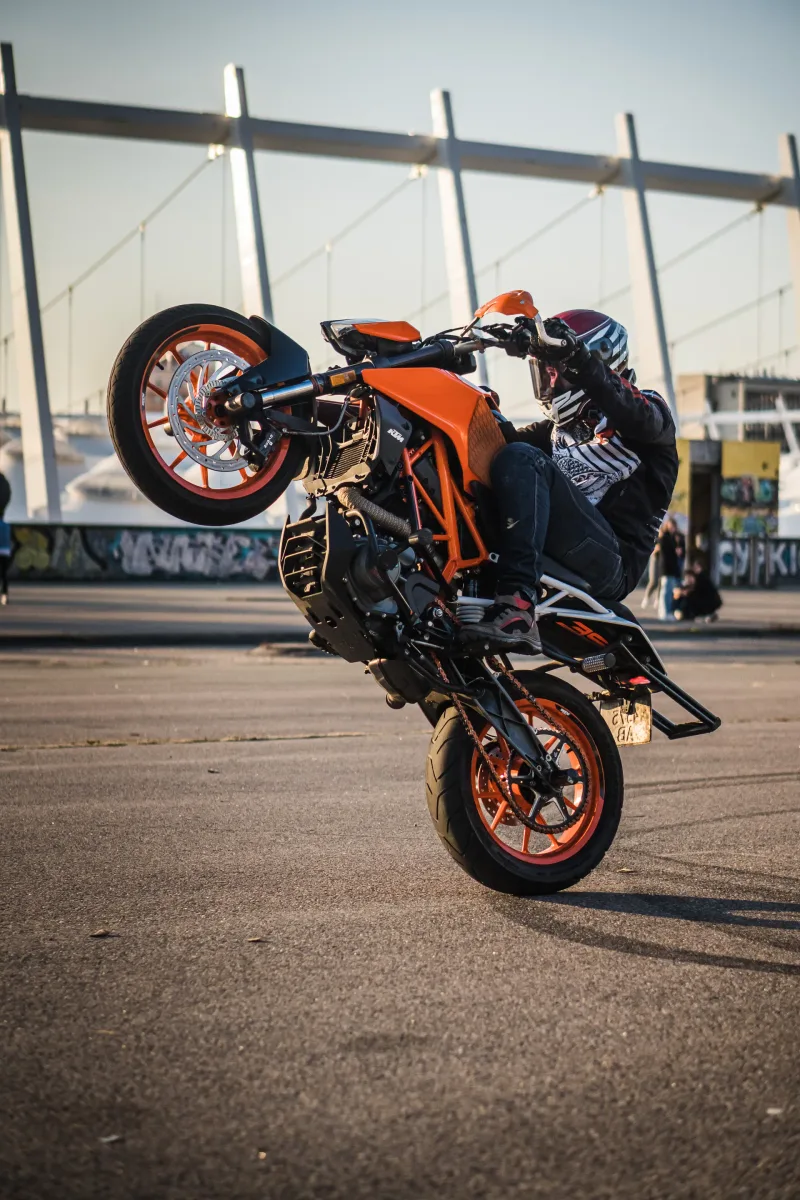
Here's a counterexample to make it clear. In stunt riding, when I need to lock the rear wheel, I brake with the clutch in. When I want to do a stoppie, I also brake and pull the clutch in at the same time. Clutch in plus a hard squeeze on the brake: that's how the wheel breaks loose easily.
Why rider training teaches you to pull the clutch in
Many riders have a reflex to pull the clutch in automatically when braking. They bring it from rider training: when someone first gets on a bike, they're told to brake and pull the clutch in right away, so they don't stall and don't lose balance.
For the first lessons at low speed, that's correct. The problem starts later, when the reflex stays and carries over into braking at speed.
In the city people get used to easy, slow braking, and it sets in as a habit.
In a panic stop, a rider usually squeezes the clutch at the same moment as the front brake. In the videos of failed braking that I've watched, this moment comes up often. It's a very common mistake, and I covered it in the 8 common braking mistakes article.
Another mistake often sits next to this one: holding the throttle open. Under stress, many people forget to close the throttle before braking. I've also seen both mistakes together: clutch pulled in, throttle still open.
When to pull in the clutch when braking: at the start or at the end
At the end. I pull the clutch in just before a full stop, when the speed is almost zero, and also when I'm downshifting quickly.
That doesn't mean the clutch is bad in itself. At low speed it's a working tool: smooth clutch control in the friction zone is the basis of low-speed maneuvering and smooth starts. I'm talking only about braking here.
How to brake without the clutch and downshift
First, the wording. «Braking without the clutch» here means «without pulling the clutch in». The engine stays connected to the wheel.
In an emergency stop I don't downshift. In my tests, braking with downshifts came out worse, and the reason is simple: there's just no time for it. I don't believe that in a life-or-death moment a person will be busy with downshifting: squeezing the brakes and yelling is realistic, shifting gears, not so much.
In normal, everyday braking it's different. If I'm going fast and I'm in a high gear, I can downshift as I slow down. Gradually, not all at once.
One more thing: don't drop several gears at a time, because the rear wheel can lock up.
To keep the downshift smooth, there's throttle blipping: a short burst of throttle while you shift down. It matches the engine revs to the rear wheel speed, and the gear goes in without a jerk.
Engine braking on a motorcycle: is it worth using
Engine braking is slowing down with a closed throttle and by shifting to a lower gear. The engine works as a brake through compression. When I close the throttle, the engine stops pushing the bike: compression in the cylinders creates resistance and slows the rear wheel. In a lower gear the effect is stronger, in a higher gear it's softer.
The engine helps slow the bike down, and that's exactly why I don't disconnect it with the clutch. But I use it as a supplement to the brakes, not a replacement.
The upside is that it's an extra way to control speed that doesn't wear out the brake pads or overheat the brakes. But in the city there's a risk too: if I slow down with the engine alone, the driver behind me doesn't see a brake light and may not realize I'm braking. So I touch the brake a little earlier to make the light come on.
How to practice braking without the clutch
The goal of these drills is to get rid of the reflex of pulling the clutch in at the start of braking and to feel how the engine helps.
- Braking in an empty lot. Start at 20 mph and build up gradually to 35–50 mph. Brake gently and increase brake pressure gradually. Pull the clutch in only just before a full stop.
- Repeat. You can usually see improvement within a few tries: by the 3rd or 4th try you'll see a result. Practice regularly, at least once a month.
- Downhill with the throttle closed. On a descent, close the throttle and feel how the engine holds your speed.
- Throttle blipping. Pull the clutch in, drop a gear, give a short blip of throttle, release the clutch smoothly. First on a straight road, then before corners. Listen to the engine: a correct blip gives a quiet, smooth shift. After that, practice consecutive downshifts, one gear at a time.
- The same in the rain. I recommend trying braking on a wet surface too. It improves your understanding of tire grip on the road. Do it carefully.
More braking errors from real crash footage:
FAQ
Should you pull the clutch in during an emergency stop?
Not at the start, and I don't downshift either. I pull the clutch in just before a full stop.
What does braking «with the clutch» and «without the clutch» mean?
«Without the clutch» means without pulling it in: I don't touch the clutch lever, and the engine stays connected. «With the clutch» means the lever is pulled in and the engine is out of the braking. There's more on clutch control in the glossary.
Can you brake with the engine only?
I use the engine as a supplement to the brakes, not a replacement. In traffic there's one more thing: without the brake, the brake light doesn't come on.
When does pulling the clutch while braking do the most harm?
At speed: the faster you go, the more harm it does.
Liked it? Share with fellow riders
Nebachiv Book and App — in progress
Get early accessRead more
Why New Riders Crash in Corners—and How You Can Avoid Their Mistakes
Learn why new riders crash in corners and how to avoid their mistakes. Master leaning, trail braking, and wide trajectories to stay safe and in control on any curve.
Why Do New Riders Fear Corners? My Journey and Lessons for Mastering Turns
Discover why new riders fear corners and how to overcome it. Personal stories, gymkhana, track, and pit bike training tips to master every turn with confidence.

Common Lane-Splitting Mistakes New Riders Make (And How to Fix Them)
Discover common lane-splitting mistakes new riders make and how to avoid them. Learn slow-speed control, smart positioning, and blocker awareness for safer, stress-free riding.
«8 Common Braking Mistakes That Most Motorcyclists Make—And How to Avoid Them»
Discover the top 8 braking mistakes motorcyclists make and how to fix them. Learn techniques to master emergency braking and reduce your risk of accidents.
«How to Brake a Motorcycle from 60 mph: Master Emergency Braking Techniques»
Master emergency braking on your motorcycle. Learn techniques, avoid common mistakes, and discover how to practice braking for maximum safety