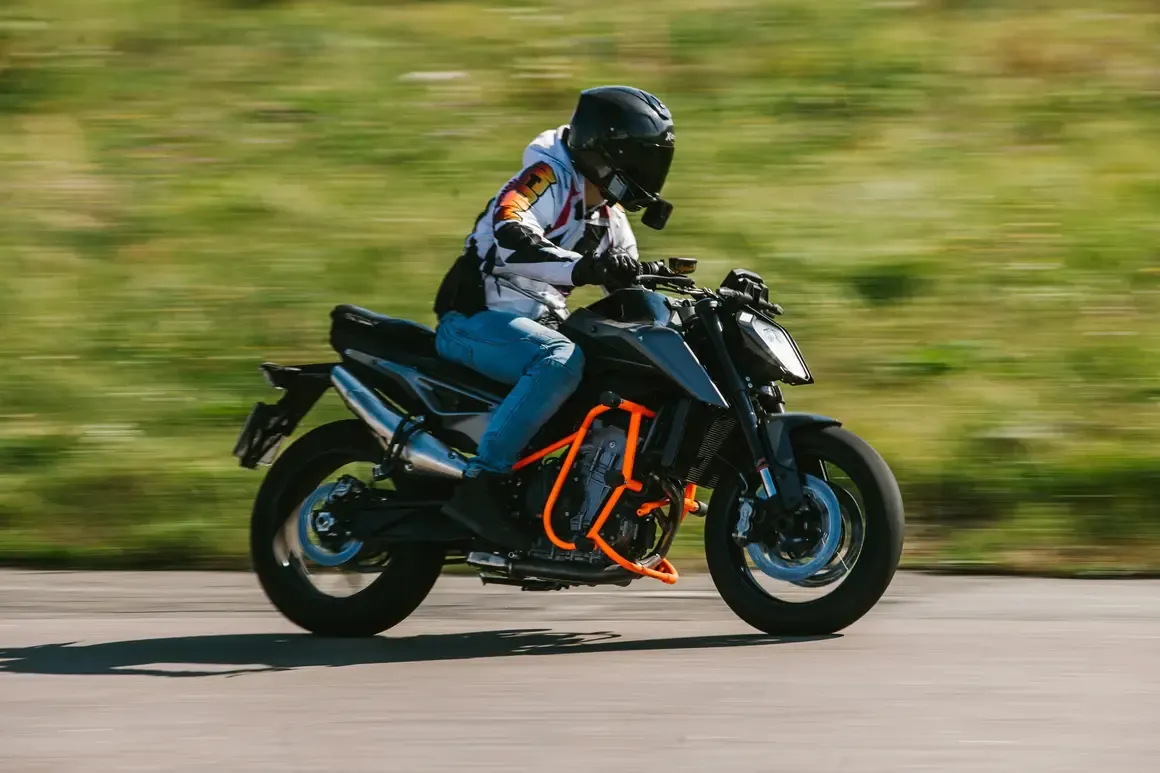
Is Speed Really the Main Cause of Motorcycle Crashes?
No, speed is usually not the main cause of motorcycle crashes. According to the European MAIDS study, in 87.9% of crashes the primary cause was human error, and in half of all cases it was the car driver's error, not the rider's. But speed multiplies my own mistakes and decides how a crash ends. My scariest moment on a motorcycle came down to exactly that.
What crash research shows
MAIDS is a European study of motorcycle crashes: 921 crashes in five EU countries. The primary cause was a car driver's error in 50.5% of cases and the rider's own error in 37.4%. In 36.6% of crashes the car driver failed to perceive the motorcycle on the road. More than half of the collisions, 54.3%, happened at intersections.
Speeds in these crashes are usually low. In 74.8% of cases the motorcycle hit at under 50 km/h (31 mph), and only 5.4% of impacts were at 100 km/h (62 mph) or more. In 18.0% of crashes the rider's speed, higher or lower than the surrounding traffic, was one of the contributing factors. In fatal crashes the picture shifts toward higher speeds, and yet in 19.4% of them the rider was doing 50 km/h (31 mph) or less before things started to go wrong.
The American numbers look similar. In 2023, 36% of motorcycle riders involved in fatal crashes were speeding, compared with 22% of passenger car drivers (NHTSA). NHTSA counts as speeding going over the limit, driving too fast for conditions, and racing. That's about a third of the riders in the worst crashes, and the figure says nothing about crashes overall.
So the question has two answers. Is speed the main cause of most crashes? No. Does speed kill motorcyclists? Yes, if you mean a sudden stop from speed.
Why speed multiplies mistakes
Braking distance grows nonlinearly with speed. Double the speed and the braking distance is four times longer. I use the formula d = v²/(2·a) for ideal pro-level braking on dry asphalt (deceleration of 11.6 m/s²): from 60 km/h (37 mph) that comes to about 39 ft (12 m), from 100 km/h (62 mph) 108 ft (33 m), from 150 km/h (93 mph) about 246 ft (75 m). Those numbers don't include reaction time.
On top of braking distance comes the time when I'm not doing anything yet. At 60 km/h (37 mph) I cover almost 56 ft (17 m) every second, at 100 km/h (62 mph) 92 ft (28 m), at 150 km/h (93 mph) 135 ft (41 m). A crash situation usually lasts a few seconds. If the distance to the obstacle is the same and I'm doing 80 km/h (50 mph) instead of 40 (25 mph), I have half the time to act and four times the braking distance, so the difference in difficulty is far more than double.
Then there's fear. I've braked on track from about 200 km/h (124 mph), and the first few times it's very scary. Because of that fear you brake very inefficiently. On the road you add stress and a lack of time, and many riders brake hard for the first time ever in a real emergency. There's a separate article on that: emergency braking, “ideal” versus “real”.
That leads to my main conclusion about speed. If I have gaps in my technique or my strategy, speed multiplies them several times over, and the odds of getting out of a crash situation become very small. Rain works the same way: both rain and speed are multipliers for sloppy skills.
Too much speed is also one of the three reasons a situation happens “suddenly”: the environment changes and I can't react in time because I'm moving too fast. The standard example is filtering between lanes fast, when a car changes lanes and I can't slow down in time. More in the article on why crashes seem “sudden”.
What it looks like on the road: my story and single-vehicle crashes
My scariest moment on a motorcycle had to do with speed. I was doing 240 km/h (149 mph) and caught up with a group of cars. I was braking, the bike was lifting into a slight stoppie, and when I went into the gap between the cars, the speedometer read 170 (106 mph). It was very close. I overestimated how far ahead I can see at over 150 km/h (93 mph), and my ability to brake and read the situation.
Every near-fatal incident I've personally had involved speeds over 150 km/h (93 mph).
The second scenario is crashes with no other vehicle. According to European statistics (ERSO, 2024), about 40% of crashes involving motorcyclists happen this way: the rider crashes on his own. The way I see it, that's usually a loss of control where there's speed and corners and the rider doesn't know how to brake properly. Once he's down and sliding at speed, the lottery starts: onto the grass or into a pole. I broke down how it happens in corners in the article on why new riders crash in corners.
What to do about it
I pick my speed relative to the potential danger. Before an intersection, an exit, or a cluster of cars, I slow down ahead of time and get ready to brake, even if I can't see a threat yet.
At least once, try an emergency stop all the way to zero from the speed you actually ride at: in an empty lot, not in traffic. Then you'll know how much distance you need to stop, and you'll be able to adjust your speed to the situation.
One more observation. The fun of a motorcycle is acceleration and corners. At high speed the fun doesn't grow in proportion, but the risk grows out of proportion. That's why I chose a naked bike for the city: it pulls great from low revs but doesn't tempt you to go too fast, because the wind pushes you back.
Where to train your read of the situation
Speed becomes a problem when I realize too late that I'm already in a situation. A beginner realizes it too late because he hasn't seen enough yet: he doesn't know how crashes begin.
I break down real crash videos in the Nebachiv app. There's also a crash-prediction game: you watch a video and practice spotting the danger earlier, while there's still time and distance to slow down.
FAQ
What speed is acceptable in the city?
Whatever I say will have little effect on your speed: you'll ride at whatever your nervous system and your ability to judge risk allow. So my advice is to do an emergency stop all the way to zero, at least once, from the speed you ride at in the city, in an empty lot, not in traffic. Then you'll know how much distance you need to stop, and you'll adjust your speed to the danger.
What speed is acceptable when lane splitting?
My rule: no more than 20 km/h (12 mph) faster than the traffic you're passing. Go faster and you can't react in time when a car suddenly changes lanes. More in the article on lane splitting for new riders.
What is the braking distance from 100 km/h (62 mph)?
Without reaction time, on dry asphalt: about 108 ft (33 m) with ideal pro-level braking (11.6 m/s²) and about 157 ft (48 m) for a rider who has taken a course (8.0 m/s²). You can estimate your own number in the braking calculator. It's worth knowing your real distance ahead of time: most untrained riders take much longer to stop.
In the app: real city riding situations on video, with pauses and explanations, then recognition tests
App access opens in waves, in the order requests come in
Get early accessLiked it? Share with fellow riders
Read more
Rear Brake on a Motorcycle: When and How to Use It
For me the rear brake is a tool for the city, low speed and slippery surfaces. In an emergency stop on dry pavement I take my foot off it. Why, and how to set up the pedal.
Motorcycle Without ABS: Do You Need It and How to Brake
I recommend getting a bike with ABS: it forgives mistakes, but it doesn't replace skill. Why the wheel locks and how I brake so I don't lock it.
Riding a Motorcycle in the Rain: Braking on Wet Roads
It's slipperiest in the first minutes of rain and when the road is drying. How I brake and open the throttle on wet roads, what I do about markings, manhole covers and rails, and how I practice.
Why Beginner Motorcycle Riders Crash in Their First Season
How beginner motorcycle riders fall in their first season: lost balance at a standstill, a panic grab of the brake on sand, locked wheels. My own falls.
Why Motorcycles Get Rear-Ended at Traffic Lights and in Slowing Traffic
A motorcycle gets rear-ended when the driver behind misses that it's slowing: engine braking shows no brake light. What I do at lights and in traffic.
Car Pulling Out of a Side Road in Front of a Motorcycle: Why It Happens and What to Do
Why a car pulls out of a side road in front of a motorcycle: a visibility blocker, perception error, driver mistake. See how I approach intersections.