
Rear Brake on a Motorcycle: When and How to Use It
The rear brake is for adjusting speed or for controlled, predictable slowing down. I use it all the time in the city: when lane splitting, in low-speed maneuvers, in ordinary calm braking. On dirty or slippery pavement it matters a lot more, because I can't squeeze the front brake hard. But in an emergency stop on dry pavement above 30 mph, I personally take my foot off the rear brake: the front is the main brake then, and that goes for cruisers and long-wheelbase bikes too.
What is the rear brake for on a motorcycle?
For me it's a working tool for the city. My foot is always on the rear brake there: it's a convenient way to adjust speed, especially when lane splitting or when I need to brake and the surface is questionable for the front.
A new rider can have trouble with throttle and clutch precision. A small movement of the hand can cause a jerk, and you lose balance. If you hold the throttle steady and just drag the rear brake, speed adjusts far more precisely. The rear brake helps you ride confidently in traffic jams; there's more on that in the article on lane splitting.
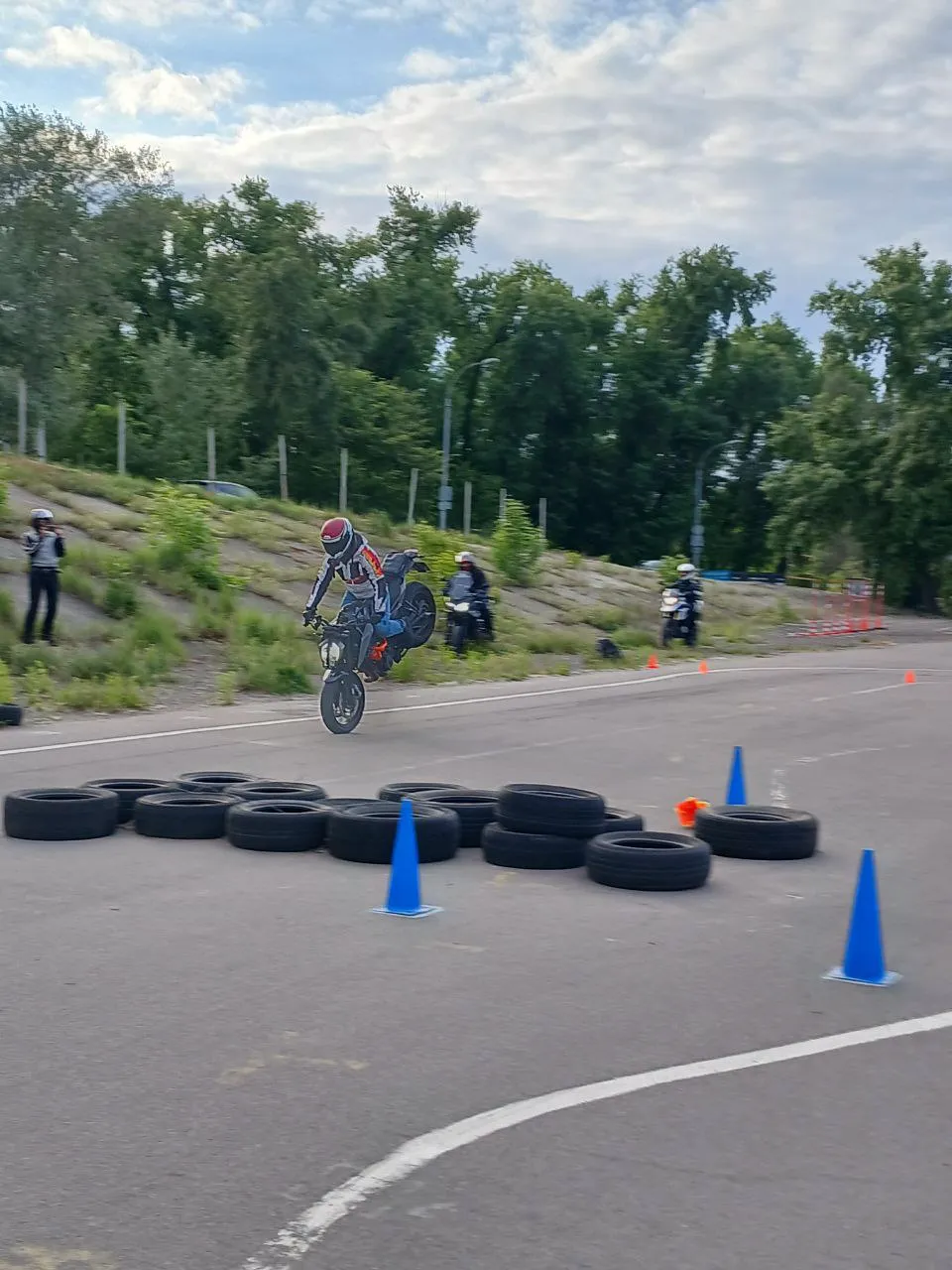
The same goes for slow riding. Most riders control low speed with the clutch. It's easier to learn maneuvers another way: steady throttle, don't touch the clutch, and control speed with the rear brake. In gymkhana, speed control with the rear brake is used a lot.
When to use the rear brake: should you use it in an emergency stop?
This section is about street and sport riding on dry, warm, clean pavement.
On paper, riding instructors usually advise that in an emergency stop you should press the rear brake right away too and hold it constant, at the edge of lockup. That's the ideal scheme. But the reality is that under stress it's not realistic. And anyone who recommends it doesn't understand this and has most likely spent little time in extreme situations. Pressing the rear brake with your foot to some constant level, say 40% pressure, in a real, sudden, stressful situation where your life is at stake, is not realistic.
Under heavy stress the body instinctively tenses up and clenches, and here you need a precise, controlled press. Picture it: you're riding along and a truck suddenly pulls out. Will you be able to pull off a complex technique and a controlled “just a little rear brake” in that situation?
There's one more factor. I usually ride street bikes, and when I brake aggressively I'm usually in a mini-stoppie, meaning the rear is unloaded as much as possible. The rear brake's contribution to overall braking is then minimal.
What I do myself: in dry conditions above 30 mph, I take my foot off the rear brake. And that's what I'd advise my best friend to do, because a foot on the rear brake in a sudden emergency stop is more likely a path to problems than a solution to them.
And if my speed is under 30 mph and my foot is already on the rear brake, I just brake with the rear. I'd also advise a beginner to keep a foot on the rear brake at low speed: you'll definitely slow down, and it definitely won't hurt.
For those who are just learning: beginners don't need to learn to press the rear in an emergency, because it complicates the process. It's better to put all 100% of your concentration into feeling progressive braking with the front.
Is it a mistake to brake with only the rear brake?
In an emergency, yes. It's one of the mistakes I covered in the article on 8 common braking mistakes.
This is usually a cruiser story, with ABS or without. They have a long wheelbase, and owners get used to braking with only the rear. But I've also seen crashes where a rider on a street bike or sport bike still brakes with only the rear brake.
Under stress the rider stomps on the rear brake with everything they have. The rear wheel locks, the bike goes into a slide, and it starts to swing around. From there come two scenarios. The first: the bike goes down in a lowside. The second: the rider gets scared, releases the rear brake, and gets thrown off in a highside. I described both scenarios in the article on lowside and highside.
Hold or release a locked rear? While the bike is still going straight: if you're going to stop anyway, hold it to the end and keep the bike upright; if your speed is high and you need to maneuver, release and brake again. If the bike has already stepped out a lot, roughly 30° or more, don't release, hold it to the end. You can't maneuver with a locked rear.
The situation is usually made worse by the fact that these are old cruisers without ABS. And one more thing: if you press the rear brake hard and pull the clutch in, it gets easier to lock the wheel. I explained why in the article on the clutch when braking.
Is the rear brake the main brake on a cruiser?
No. On cruisers and long-wheelbase bikes the main brake is still the front. Especially if they have no ABS: then the rear wheel will almost certainly lock up, because modulating with your foot under stress is impossible. So if there's no ABS, I'd also take my foot off the rear brake and get ready to brake with only the front. If there is ABS, you can probably leave it on; I would.
How to use the rear brake on different surfaces: wet, sand, gravel
On wet pavement the front brake is still your main brake. It's just that the braking takes longer to start, and the press on the brake is smoother. Compared with dry, on wet we press roughly one and a half times more smoothly in time: if on dry the initiation takes, say, 0.5 to 0.7 seconds, on wet it will be about a second or 1.4 seconds. But you can still apply almost the same braking intensity. You just have to watch for front wheel lockup or for the ABS kicking in: that's essentially the same thing, because ABS activation is the reaction to the wheel locking.
On dirty or slippery pavement you should brake smoothly, mostly with the rear brake.
Road markings, crosswalks, tar patches, metal manhole covers: all of it is slippery. I wouldn't brake with the front on these surfaces.
Sand, gravel, and a dusty road: we don't use the front brake, only a light rear.
Rear brake in a corner
In problem corners it's best not to brake at all; better to straighten up.
If the problem is in the corner, it depends on the surface. On dry pavement it's better to use the front brake, if you have trail braking skill. If you don't, you can try the rear, but its effect is, I'd say, questionable. It's better than not braking at all. Better still, learn to brake in a corner with the front and understand how much front brake to give depending on speed and lean angle.
A sharp press on the rear brake in a corner does harm: you'll go into a lowside from the rear wheel sliding out. If the rear wheel is already sliding, keep the throttle steady and don't close it sharply. And don't suddenly release the rear brake until you've regained control.
How to set up and modulate the rear brake
Start with the pedal. On a lot of bikes the rear brake pedal tip sits quite high from the factory. That makes it uncomfortable to keep your foot on it all the time, and people often squeeze the brake too hard. You just need to lower the tip, and it's easy to do.
Next, foot position. My left foot sits on the peg on the ball of the foot, so I can stand up very quickly. My right foot rests flat with the heel on the peg, so it can work the rear brake.
On modulation. In the city you can drag the rear brake with a steady throttle. On a dry road in ordinary braking the rear works all the time, but lightly. In stressful situations riders often make mistakes with the rear brake, and it can cause a skid.
The rear wheel is fairly easy to handle. If you lock the rear wheel in a straight line during practice, nothing will happen to you. I'd strongly advise locking both the rear wheel and the front one too, in a straight line, just to feel it and understand how to work it out.
How to practice the rear brake
- A parking space. Ride into a parking space and try to hold yourself in it for 10 seconds, using fine clutch control and the rear brake. This practice teaches you to use the clutch and rear brake for precise riding.
- Steady throttle and rear brake. At low speed hold the throttle steady, don't touch the clutch, and control speed with only the rear brake.
- Gymkhana. The rear brake is used constantly there in maneuvers.
FAQ
When should you use the rear brake?
In the city, when lane splitting, in low-speed maneuvers, in calm braking, on dirty or slippery pavement. In an emergency stop on dry pavement above 30 mph, I personally take my foot off the rear brake.
Is it a mistake to brake with only the rear?
In an emergency stop, yes. Under stress the rear wheel locks, the bike goes into a slide, and if you release the brake once the bike has already swung around, it's a highside.
Can you lock up the rear wheel with the brakes?
Yes. A sharp press on the rear brake usually locks the wheel, and with the clutch pulled in it happens even more easily.
Is the rear brake the main brake on a cruiser?
No, the main brake there is the front too. Without ABS the rear wheel will almost certainly lock up, so I'd take my foot off the rear brake; with ABS you can probably leave it on.
Does rear brake use change on a long descent or with a passenger?
Yes. If I'm going down a long descent with a passenger, I try to use engine braking instead of riding the brake, because on a prolonged descent you can simply overheat the brake fluid. If you've never overheated brake fluid, here's how it goes: the brakes just fade, and the bike doesn't stop. To avoid that, first, it's worth overheating the brakes once to feel how they get spongy and weaker or stop working altogether. It's best to feel it with intense front braking: within ten tries you'll feel it. If you practice at gymkhana and keep braking with the rear, there will definitely be a moment when the rear brake fades. So ideally don't ride the brake constantly, so you don't overheat the brake fluid.
You also need to know what fluid you have in there, and it's better to choose one that's more heat-resistant. There are cheaper and more expensive ones; when I do motorsport or gymkhana, I fill in the more expensive one. DOT 3, DOT 4 and DOT 5.1 are glycol-based and compatible with each other: a higher grade can be topped up in place of a lower one. DOT 5 is silicone-based and doesn't mix with the others. Fill in whatever is written on the brake reservoir cap.
Liked it? Share with fellow riders
Nebachiv Book and App — in progress
Get early accessRead more
Motorcycle Without ABS: Do You Need It and How to Brake
I recommend getting a bike with ABS: it forgives mistakes, but it doesn't replace skill. Why the wheel locks and how I brake so I don't lock it.

Riding a Motorcycle in the Rain: Braking on Wet Roads
It's slipperiest in the first minutes of rain and when the road is drying. How I brake and open the throttle on wet roads, what I do about markings, manhole covers and rails, and how I practice.

“8 Common Braking Mistakes That Most Motorcyclists Make—And How to Avoid Them”
Discover the top 8 braking mistakes motorcyclists make and how to fix them. Learn techniques to master emergency braking and reduce your risk of accidents.
“How to Brake a Motorcycle from 60 mph: Master Emergency Braking Techniques”
Master emergency braking on your motorcycle. Learn techniques, avoid common mistakes, and discover how to practice braking for maximum safety

Why City Riders Crash in Corners—and How to Avoid It
Why do city riders crash on serpentines? Discover how to avoid low-sides and high-sides with proper leaning, trail braking, and safety techniques for cornering.
Common Lane-Splitting Mistakes New Riders Make (And How to Fix Them)
Discover common lane-splitting mistakes new riders make and how to avoid them. Learn slow-speed control, smart positioning, and blocker awareness for safer, stress-free riding.